DECUS and the PDP-1 community
The Computer History Museum traces DECUS to a 1961 meeting of PDP-1 users who wanted to create a shared program library.
source-chm-decusThe DECUS.org Digital Archive
A read-only reconstruction of technical forums, software, people, ideas—and our beloved computing community from the good old days.
Preserved by Eric Bach, administrator from 1990.
$ DIRECTORY DECUS.ARCHIVE
_
Explore the archive
Designed for former members, practitioners, historians, students, and the simply curious.
Read recovered discussions by system, language, year, and topic.
Explore →02Find manuals, proceedings, technical notes, scans, and source records.
Explore →03Enter the systems, people, and online culture remembered from Eric’s era.
Explore →04Trace public contributions by authors, moderators, speakers, and engineers.
Explore →The Computer History Museum traces DECUS to a 1961 meeting of PDP-1 users who wanted to create a shared program library.
source-chm-decusArchive principle 01
Original records, external sources, Eric’s recollections, curatorial context, and reconstructed layouts are labeled separately. Missing evidence stays missing—never manufactured.
Understand the evidence labels →The online community
DECUServe began in March 1987 as a dial-up meeting place for DECUS members. Its DEC Notes conferences turned technical exchange into a daily practice years before the modern web.
Read the preserved history ↗DECUSERVE::NOTES> DIRECTORY

The first Reddit—before Reddit
That phrase is a modern metaphor, not a literal historical claim. DECUServe was smaller, slower, and far more accountable than a mass social network: the handle on screen often belonged to someone you knew from a symposium, a special-interest group, or the machine room.
The internet could feel like a neighborhood—and a precise answer from one practitioner could change another site’s entire week.
Questions were rarely abstract. A cluster was misbehaving. A compiler emitted something strange. A driver needed one more insight. The reply often came from someone operating the same system under real pressure.
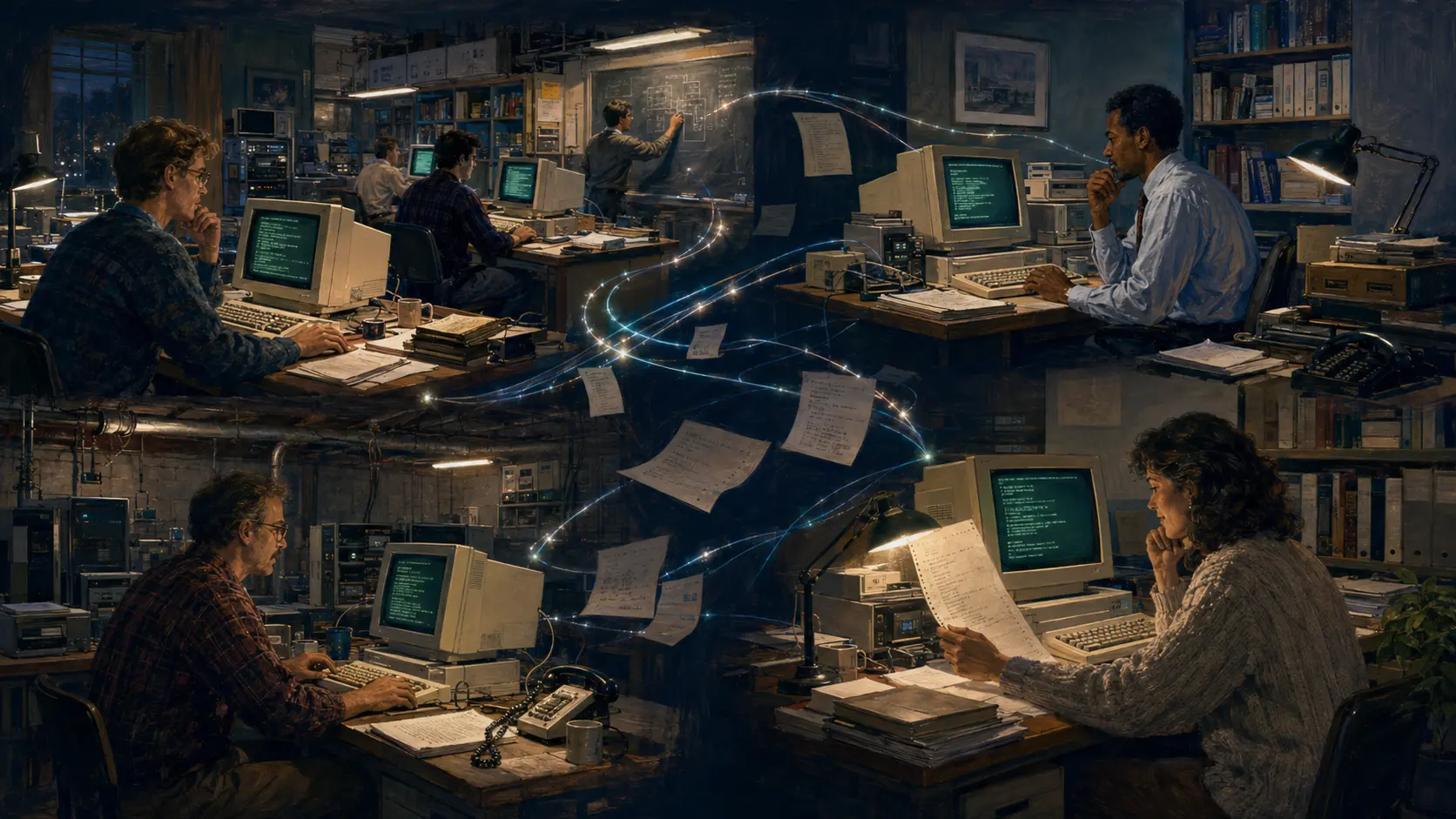
You knew the handle—and, often, the person and the systems behind it.
Expertise accumulated in useful answers, working code, and careful corrections.
Knowledge moved both ways: question, fix, shared program, better practice.
What made it feel different
These are curatorial interpretations of the working culture described by surviving sources and participants, not quotations from a single historic document.
A useful reply stayed attached to the person who gave it. Credibility was earned in public, one careful contribution at a time.
Chronology, subject, and shared context—not engagement ranking—organized the conversation.
The person explaining a system was often running, repairing, benchmarking, or extending one that day.
A configuration detail, code fragment, or field report could spare another team hours of uncertainty.
Program libraries and special-interest groups gave users a practical voice in what systems could become.
Networking, distributed systems, languages, and interfaces were not settled products. They were open questions.
Open the reading room
Original scans and catalog records remain with independent custodians. These links open preserved material in a new tab; DECUS.org does not claim ownership of it.
Proceedings · PDF
A surviving volume from DECUS's earliest years: practical papers, program notes, and the texture of a user community learning in public.
Program library record
A Computer History Museum record of the practical machinery behind shared software: submission, documentation, copying, and exchange.
Magazine collection
Newsletters, reports, technical articles, and community announcements preserved as a browsable run of period publications.
Community ephemera · PDF
A modest form that opens a larger window onto participation: interests, systems, geography, and the human network behind the machines.
Proceedings collection
A substantial independent collection of symposium proceedings—evidence of how users documented systems, applications, and hard-won solutions.
Call for papers · PDF
A period call for papers that captures a community poised between mature minicomputing practice and the networked decade about to begin.
From peer network to networked world
DECUS was not the dot-com revolution. But it embodied habits that would become foundational: sharing code across distance, asking peers before vendors, building identity through contribution, and treating a network as a place where a community could live.
By 1990, development felt ready to explode. The public web, commercial internet, and start-up boom would change the scale and speed. The earlier culture had already demonstrated the appetite.

Knowledge systems
The final taxonomy will follow recovered records. These are representative terms, not claims of collection completeness.
1990 time capsule
Eric Bach’s account anchors the reconstruction of the 1990 administration era. The archive will present that memory with dignity—without confusing it with verified institutional history.
Enter the 1990 time capsuleDECUServe opens as a dial-up online meeting place using the DEC Notes character-cell conferencing system.
The archive records Eric Bach's account of administering the online community from 1990. Supporting records are being sought and will be labeled separately.
Contemporary references point to decus.org for FTP, symposium material, email services, and a U.S. DECUS home page.
Preservation statement
The public site has no accounts, comments, uploads, admin panel, or write path. After the archive is sealed, only documented factual corrections, rights actions, accessibility fixes, and preservation migrations are permitted.
Read the full archive policy →