1962External preservation
Proceedings · PDF
The first DECUS Proceedings
A surviving volume from DECUS's earliest years: practical papers, program notes, and the texture of a user community learning in public.
Knowledge library
The library will unite manuals, proceedings, newsletters, scans, technical notes, and searchable transcripts without separating an artifact from its source history.
Attachments & reading room
Proceedings, newsletters, program-library records, and community ephemera show how the culture actually worked. Files open at the preserving institution; dates, custodians, and formats stay visible.
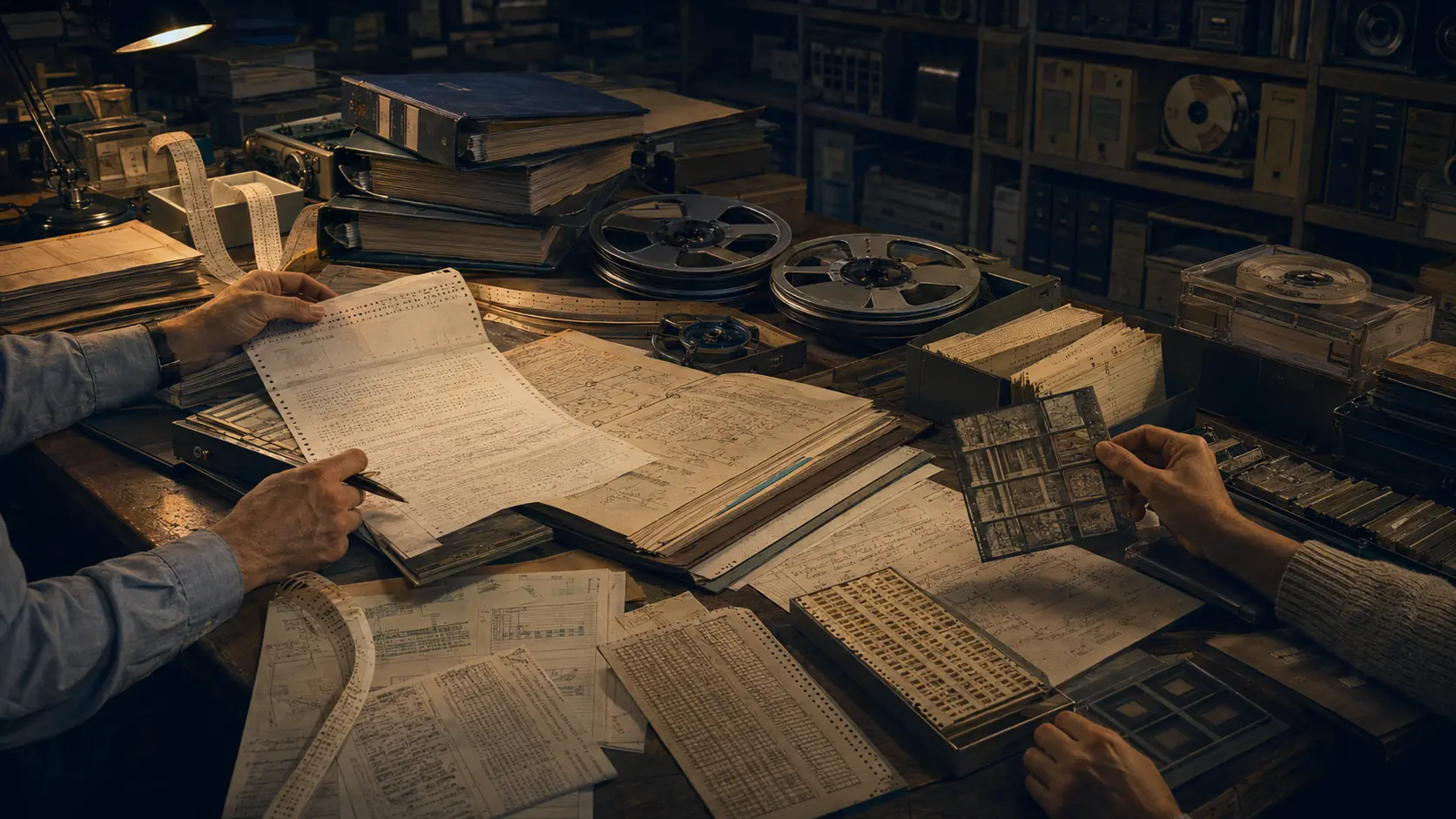
A visual interpretation of the proceedings, listings, tapes, cards, and working notes through which programs and knowledge traveled. It does not reproduce a specific archive object.
Proceedings · PDF
A surviving volume from DECUS's earliest years: practical papers, program notes, and the texture of a user community learning in public.
Program library record
A Computer History Museum record of the practical machinery behind shared software: submission, documentation, copying, and exchange.
Magazine collection
Newsletters, reports, technical articles, and community announcements preserved as a browsable run of period publications.
Community ephemera · PDF
A modest form that opens a larger window onto participation: interests, systems, geography, and the human network behind the machines.
Proceedings collection
A substantial independent collection of symposium proceedings—evidence of how users documented systems, applications, and hard-won solutions.
Call for papers · PDF
A period call for papers that captures a community poised between mature minicomputing practice and the networked decade about to begin.
The Computer History Museum traces DECUS to a 1961 meeting of PDP-1 users who wanted to create a shared program library.
VMS Software documents DECUServe's March 1987 launch, its dial-up origins, DEC Notes conferencing system, and daily-community role.
A surviving catalog demonstrates the extraordinary range of user-contributed software, utilities, languages, scientific tools, and games.